


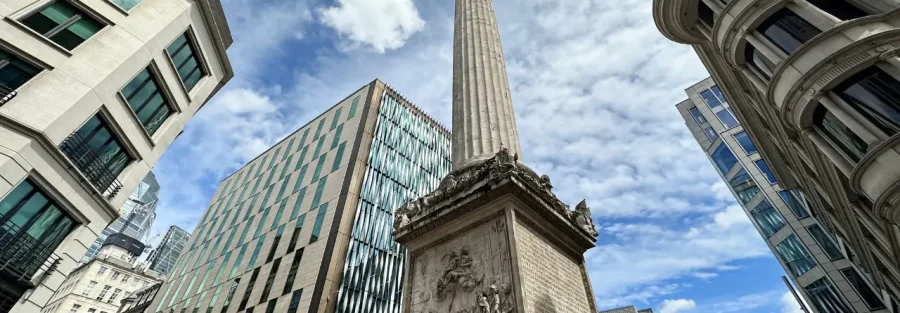
How disaster forced early frameworks of insurance, rebuilding, and modern city planning mindset
The Great Fire of London in 1666 is often remembered as one of the most destructive urban disasters in British history. In just four days, a large part of the medieval city was reduced to ashes, reshaping not only the physical landscape of London but also how societies think about risk, responsibility, and urban resilience.
Beyond the immediate devastation, the fire marked a turning point. It forced early thinking around structured rebuilding, insurance mechanisms, and planned urban development. In many ways, it became one of the earliest examples of “urban risk thinking”, a concept that remains central to modern cities today.
A disaster that exposed structural fragility
The fire began in a bakery on Pudding Lane and quickly spread through tightly packed wooden buildings, narrow streets, and highly flammable materials. By the time it was contained, it had destroyed an estimated 13,000 to 15,000 buildings, including St Paul’s Cathedral, and displaced tens of thousands of residents.
Historical estimates suggest that around 80,000 people were left homeless in a city of roughly 350,000 inhabitants at the time. The scale of destruction highlighted how unregulated urban growth can amplify risk, especially when construction materials and city layouts are not designed with safety in mind.
Today, London is one of the world’s most densely populated and economically significant cities, generating over £500 billion in gross value added annually according to recent UK economic data from the Office for National Statistics. The contrast between modern resilience and its fragile origins underscores how foundational the lessons of 1666 have been.
The beginning of structured insurance thinking
One of the most significant long-term outcomes of the Great Fire was the evolution of fire insurance. In the aftermath, the need for financial protection against large-scale loss became undeniable.
By the late 17th century, Nicholas Barbon established one of the first fire insurance offices in London. This marked a shift from informal mutual aid to structured risk pooling. Property owners could now transfer part of their financial exposure to a formal institution, an early version of what we now recognise as insurance underwriting.
This concept would eventually evolve into modern global insurance markets. Today, the UK insurance industry manages billions in annual premiums and remains a global leader in risk management innovation. For example, Lloyd’s of London, which traces its roots to the late 17th century coffeehouse trading culture that followed the Great Fire era, continues to underwrite complex global risks across industries and geographies.
The key transformation began here: risk was no longer viewed purely as misfortune, but as something that could be measured, priced, and shared.
Rebuilding London and the rise of urban planning
In the aftermath of the fire, rebuilding London was not left to chance. King Charles II commissioned Sir Christopher Wren and others to redesign key parts of the city. Although a fully planned redesign was not fully implemented due to property rights and urgency, several important reforms were introduced.
One of the most significant changes was the shift from wooden structures to brick and stone construction. Building regulations were introduced to reduce fire risk, including wider streets and improved building standards. These measures represented an early form of urban regulation driven by risk awareness rather than aesthetic design alone.
The rebuilding process also demonstrated an early recognition of infrastructure resilience. Essential buildings such as churches, public offices, and marketplaces were reconstructed with durability and long-term functionality in mind.
Modern urban planning principles still reflect these early lessons. Contemporary cities now integrate fire codes, zoning laws, and emergency response systems as standard practice. According to the London Fire Brigade, modern fire-related incidents in London are now managed within highly regulated frameworks, contributing to significantly lower fatality rates compared to historical levels, despite a far larger population.
From disaster to systems thinking
Perhaps the most important legacy of the Great Fire of London is the emergence of systems thinking in urban governance. Before 1666, cities largely evolved organically, shaped by trade, geography, and population growth. After the fire, there was a growing recognition that cities require structured oversight to manage risk effectively.
This shift laid the foundation for modern disciplines such as urban planning, risk management, and public safety regulation. It also influenced how governments and private institutions collaborate in managing large-scale uncertainty.
The idea that risk can be mitigated through design, regulation, and financial instruments is now central to how modern societies operate. From flood defenses to cyber insurance, the intellectual lineage of these systems can be traced back to early responses to catastrophic events like the Great Fire.
Conclusion
The Great Fire of London was not only a moment of destruction but also a catalyst for transformation. It exposed the vulnerabilities of an unregulated city and triggered foundational changes in insurance, construction, and governance.
More importantly, it introduced a new way of thinking. Risk was no longer something to simply endure, but something to understand, structure, and manage. That mindset continues to shape modern cities, financial systems, and organisational resilience frameworks.
In many ways, the fire did not just rebuild London. It rebuilt the concept of how societies prepare for uncertainty.